Zero Sum Thinking Will Destroy Us All
Why the obsession with Greenland reveals a dangerous misunderstanding of power in the modern world

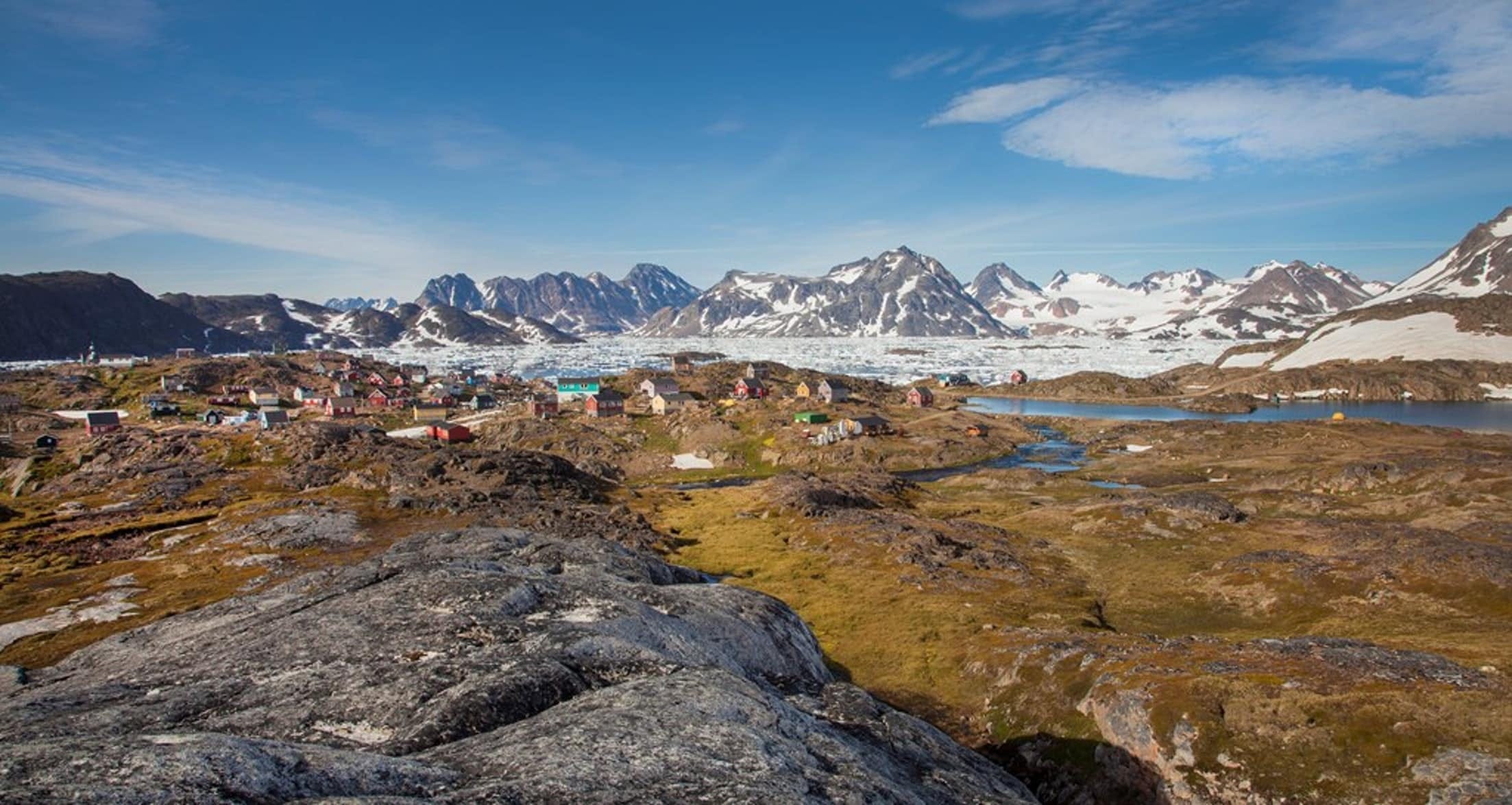
Greenland has come to dominate headlines and elite foreign policy discourse in a way that is wildly disproportionate to its actual significance. More than almost any other issue tied to this administration, it keeps me up at night. Not because the Greenland situation is likely to trigger immediate armed conflict among allied Western countries, but because the stakes of miscalculation are extraordinarily high and deeply self-destructive.
That miscalculation does not require tanks or missiles. It unfolds more quietly through alliance erosion, investment uncertainty, and the normalization of coercive leverage among partners who have historically relied on trust.
It is rare in the postwar era for a piece of Allied territory to attract this level of strategic fixation absent an actual crisis. The reasoning that elevates Greenland into an existential prize is fundamentally flawed. Applied consistently, it points not toward security or prosperity, but toward mutually assured destruction.
More troubling still, it reflects a deeper zero-sum worldview. One that mistakes land and raw materials for the true sources of power in a twenty-first century economy.
Greenland’s importance is vastly overstated
Greenland is large, but the common perception of its scale is often an illusion created by map projections. The Mercator projection, used for most maps, dramatically exaggerates landmasses at high latitudes, making Greenland appear continental. In reality, Greenland is comparable to Mexico or Saudi Arabia and smaller than Algeria.
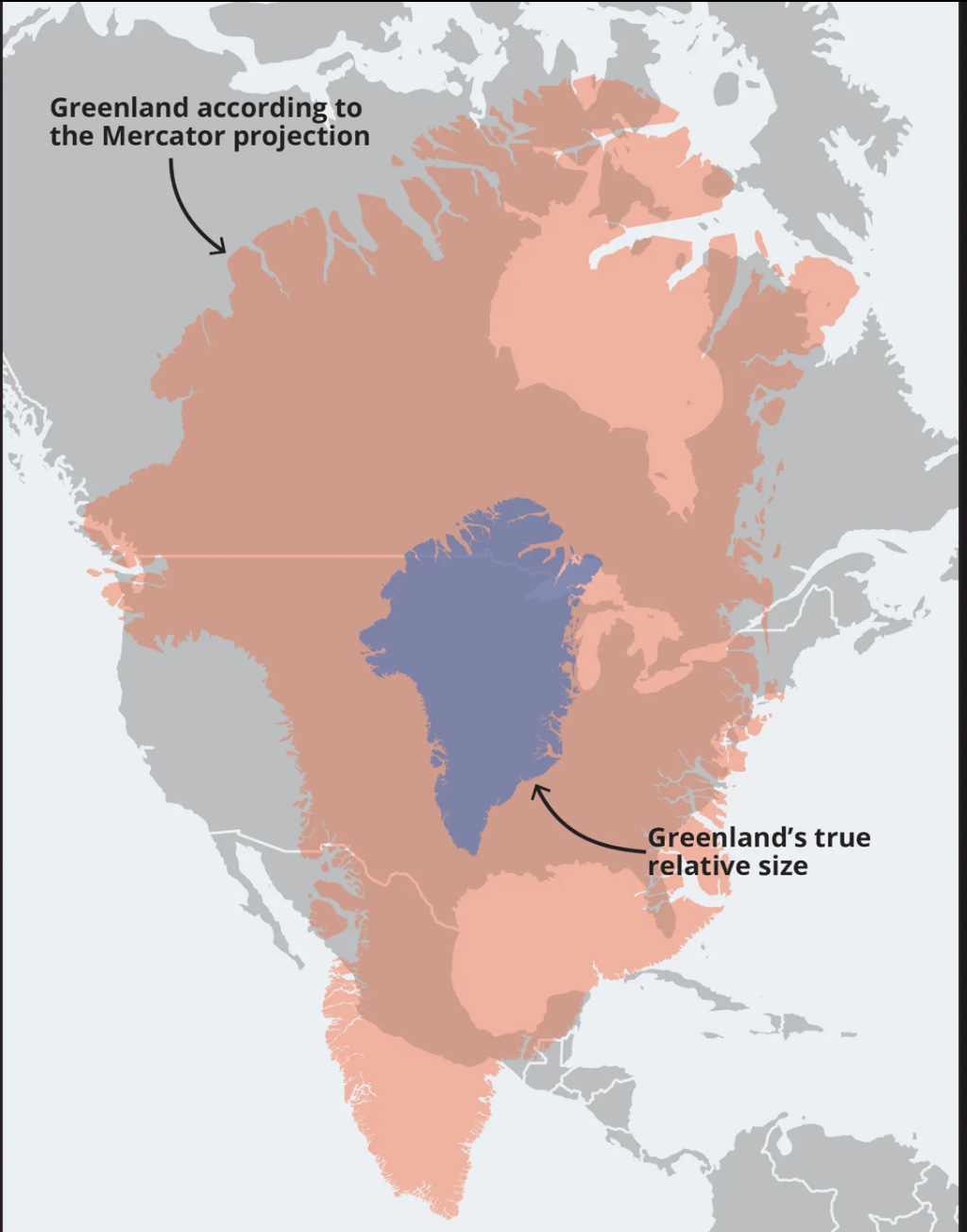
More importantly, most of Greenland is not functionally usable land. More than 80 percent of the island is covered by a permanent ice sheet, and much of the remainder consists of mountainous and extreme terrain. The area that can realistically support infrastructure is a small fraction of what the map suggests.
These physical constraints translate directly into human and economic limits. Greenland does not have the population base or internal connectivity of a strategically autonomous territory. With roughly 56,000 people concentrated in scattered coastal settlements, the island lacks a meaningful internal transportation network. Towns are not connected by roads, and movement depends almost entirely on air and sea transport, making logistics costly and vulnerable.
In Arctic terms, Greenland is not uniquely positioned. Canada’s Arctic territories span several million square kilometers, much of it ice-free. Alaska, while smaller in raw land area, has ports, highways, and a population exceeding 700,000, providing a level of integrated economic power Greenland cannot currently match.
Greenland is undeniably large in geographic terms, but physical size does not translate into functional power. Strategic relevance depends on accessibility, infrastructure, and the ability to sustain economic activity. By those measures, Greenland’s practical importance is far more limited than its map presence implies.
Greenland does not possess unique or monopolizable resources
Greenland contains critical minerals, but none are unique or monopolizable, and its potential contribution must be understood in the global context.
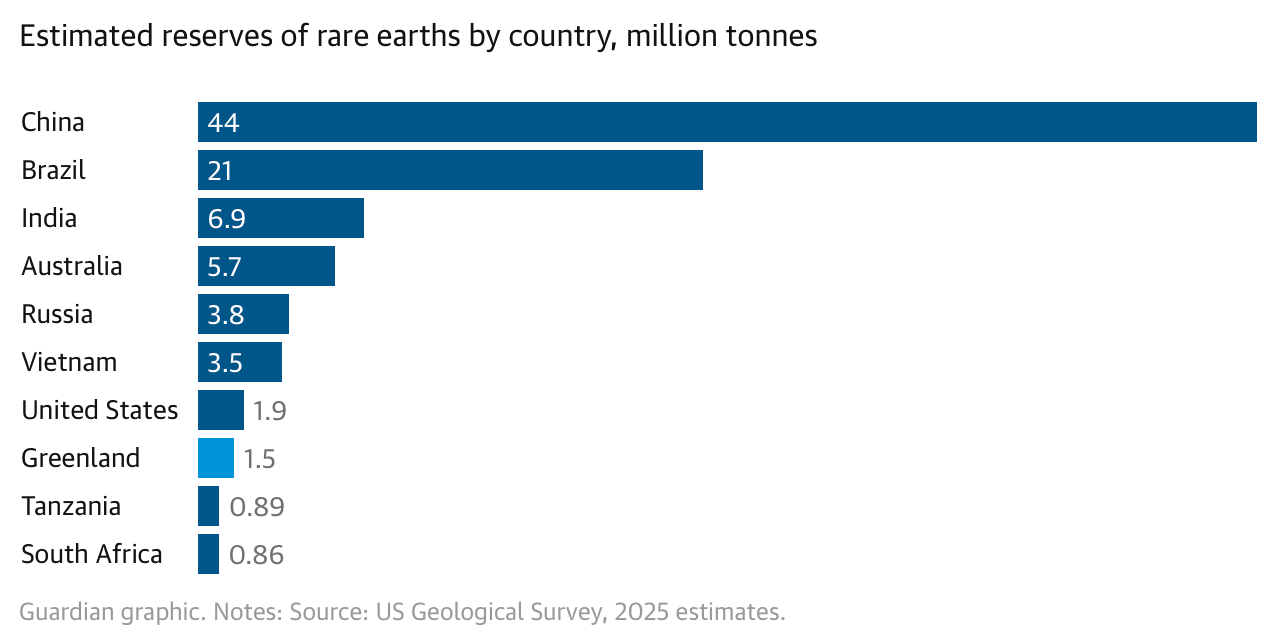
Its most frequently cited asset is rare earth elements. Even here, the scale is often misunderstood. Greenland’s estimated rare earth reserves amount to roughly 1.5 million metric tons, a small single-digit percentage (approx. 1.25–1.6%) of the global 90+ million ton total. Geological presence does not equate to producible supply.
Even under optimistic assumptions, Greenland’s potential rare earth output would represent a modest share of global annual production. Global production today exceeds 390,000 tonnes per year, with China producing roughly two-thirds of that total and controlling over 90% of processing and refining capacity, which is the real bottleneck in these markets.
Production outside China is already distributed across Australia, the United States, Southeast Asia, and parts of Africa. Over the long-term, Greenland could modestly strengthen diversification, but it would not meaningfully alter control over global rare-earth flows.
The same proportional reality applies to other critical minerals. Greenland hosts graphite, lithium, copper, nickel, and zinc deposits, but global production of these materials already runs into the millions of tonnes per year, dominated by established producers in Australia, Chile, Indonesia, and the Democratic Republic of Congo.
In proportional terms, Greenland potentially offers modest diversification, not dominance.
The real bottleneck is processing and time, not reserves
The binding constraint in critical minerals is not geological scarcity. It is the processing capacity and time.
Most critical minerals are geologically abundant and distributed across dozens of countries. What is scarce is the ability to refine and process them cheaply, at scale, and in ways that societies are politically and environmentally willing to tolerate.
The Real Constraints are Straightforward:
Processing and Refining Capacity: While many countries mine ore, China currently controls roughly 91% of the world’s rare earth separation and refining capacity.
Environmental and Political Tolerance: China dominates critical mineral supply chains not because it holds most global reserves, it holds only about 37-42%, but because it built deeply integrated refining ecosystems and absorbed environmental costs that other countries chose to avoid.
Decades-Long Investment Timelines: The second binding constraint is time. Bringing new supply online typically takes 17.9 years on average globally. Ironically, in more regulated jurisdictions like the U.S., the timeline from discovery to production can stretch to 29 years.
Building a mine is hard.1 Building a full refining ecosystem is harder.
Supply responds slowly to sharp increases in demand driven by electrification, advanced manufacturing, and defense modernization. This is not an argument against strategic resource planning; it is an argument against confusing long-term diversification with coercive territorial logic that produces immediate results. Territorial control does not shorten permitting timelines, create processing capacity, or substitute for decades of industrial investment.
Climate change will not transform Greenland into an economic frontier
Climate change is often cited as a reason Greenland’s strategic and economic value will rise dramatically, but this rests on assumptions about environmental transformation that mainstream science does not support. It also overstates how quickly physical change translates into economic relevance. Recent projections, which cluster around 2.5°C of warming under current policies, reinforce this: impacts are serious but fall short of apocalyptic scenarios in which Greenland becomes a strategic necessity. Most credible projections suggest a significant but manageable change rather than an extreme transformation redefining Greenland as indispensable to global power competition.
Greenland’s ice sheet is vast, with an average thickness of over 1.5 kilometers. Even under high-warming scenarios, climate models project its persistence over century-scale timelines. Ice loss is expected at the margins, but there is no credible pathway in which warming rapidly removes the ice sheet or exposes large areas of usable land within any relevant planning horizon.
Crucially, climate change is not “terraforming.” A few degrees of warming alter ice dynamics, but they do not convert an Arctic environment into a temperate one. Greenland will remain characterized by long winters, limited sunlight, and permafrost constraints, all of which impose durable limits on settlement, infrastructure, and productivity.
At most, climate change may bring incremental operational changes, such as slightly longer construction seasons and reduced seasonal sea ice. These may lower costs at the margin, but they do not overcome structural constraints of remoteness and sparse population.
Arctic sea lanes will be marginal, not revolutionary
Arctic shipping routes are often portrayed as a coming geopolitical game-changer. Their impact is far more likely to be modest. At best, Arctic passages can reduce transit times between parts of East Asia and Northern Europe by five to ten days, but only during a short seasonal window. They do not fundamentally alter where trade flows, how supply chains are organized, or who controls global commerce.
More than 90 percent of global maritime trade continues to move through established routes such as the Suez Canal, the Panama Canal, and the Malacca Strait, which together handle tens of thousands of vessel transits each year. By contrast, Arctic routes see only a few dozen full transits annually. For most shipping companies, these Arctic routes are economically marginal and will remain so.
The reasons are structural. Arctic shipping is seasonal, unpredictable, and costly. Ice conditions vary year to year, ports are sparse and shallow, search-and-rescue capacity is limited, and insurance premiums are significantly higher. Many vessels require ice-class reinforcement or an icebreaker escort, which erodes much of the theoretical time and fuel savings.
Crucially, Arctic sea lanes are only valuable in a peaceful and legally stable environment. Their use depends on multinational coordination for navigation, ice monitoring, and port access. Militarization or coercive control would not increase their utility; it would make them less usable.
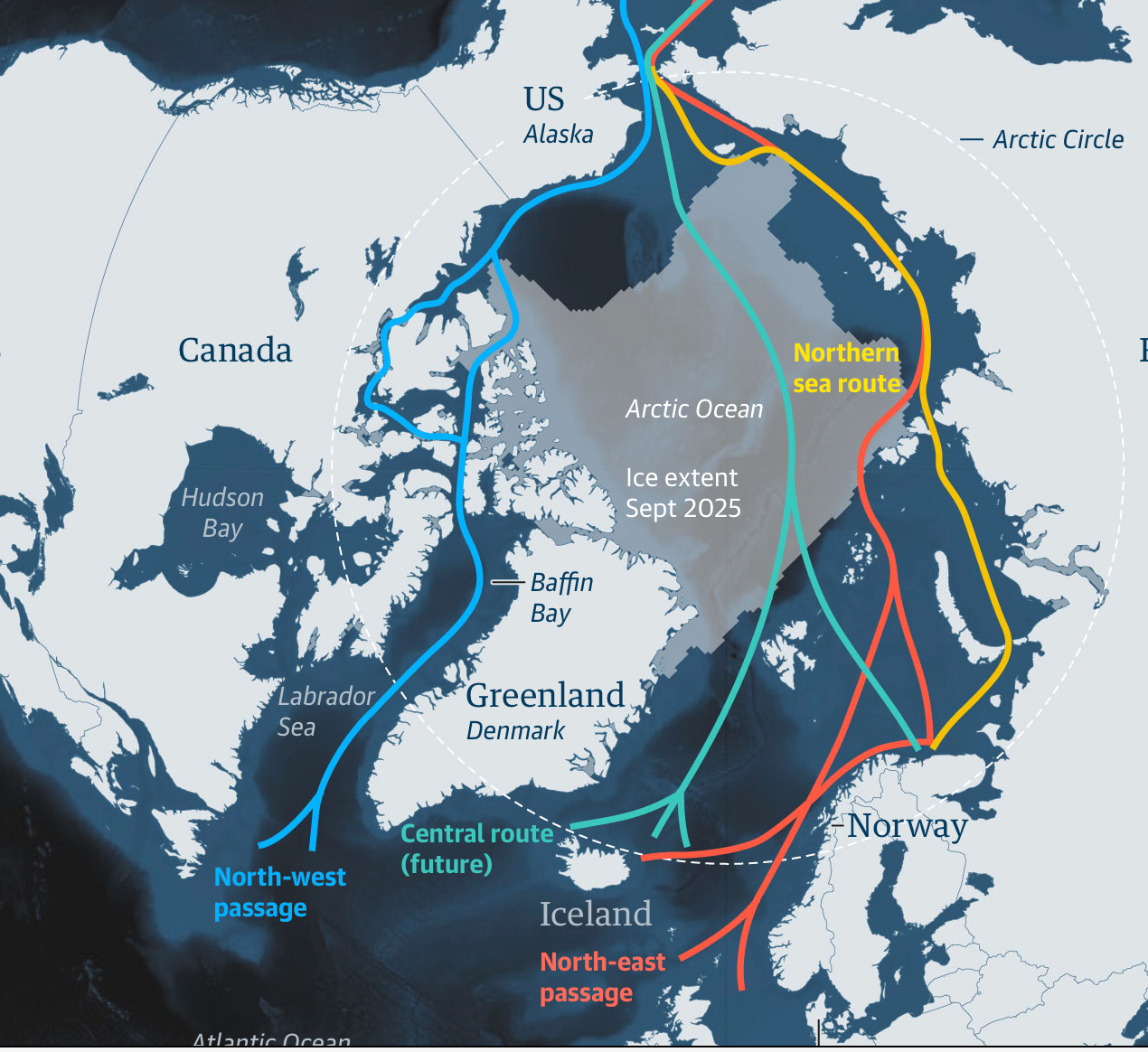
This reality also undercuts the idea that territorial control over Greenland could confer dominance over Arctic shipping. Even in the implausible scenario of a unilateral takeover, the United States would still face the fact that large portions of Arctic sea routes run through or alongside Russian and Canadian waters. Russia controls extensive stretches of the Northern Sea Route, while Canada asserts jurisdiction over much of the Northwest Passage. No single actor can control Arctic shipping without cooperation from others.
For Greenland, this distinction is decisive. Its strategic relevance does not come from dominating trade routes or chokepoints. It comes from being embedded in a stable, rules-based system that allows limited Arctic navigation to function at all. Greenland’s value depends on stability, coordination, and law, not force.
The deeper error: mistaking commodities for wealth
The fixation on Greenland is not a serious strategy. It is instead a symptom of a distorted way of thinking about society and economics.
It reflects a common tendency to interpret the world through a zero-sum lens, treating territory, resources, and control as substitutes for trust, institutions, and cooperation. That worldview misunderstands how power is generated in the modern global economy. Worse, it leads states toward choices that are strategically self-defeating, even when they appear assertive in the short term.
In the twenty-first century, wealth and security do not come from nominally owning land or extracting raw materials. They come from human social systems that allow complex coordination at scale. Stable alliances, credible legal frameworks, open markets, and predictable institutions matter more than geographic and geologic determinism. These social systems are based on trust, take decades to build, and only moments to undermine.
Greenland does not change this reality. Its size, its minerals, and its geography do not provide a shortcut around the foundations of modern power. Treating it as an object of competition among allies weakens the very conditions that make long-term security and prosperity possible. It replaces cooperation with coercion and substance with symbolism.
Rocks do not create prosperity.
Critical minerals matter only because they are inputs into advanced technology. Power comes from the social systems that turn raw materials into capabilities for humans. At the center of those systems is trust.
Trust that contracts will be enforced.
Trust that borders will not be changed by force.
Trust that trade and investment will not be arbitrarily weaponized.
When these conditions erode, capital retreats, innovation slows, and alliances fray, regardless of how much territory or how many resources a country controls.
The real danger is that zero-sum thinking will spread. Once partners are treated as rivals and territory as leverage, the logic does not stop at the Arctic. It spreads across alliances, corrodes credibility, and suppresses the investment and cooperation on which modern power depends.
Zero-sum thinking did not build the postwar order, and it will not sustain it. If it becomes the organizing principle of policy, the result will not be renewed strength, but strategic self-harm with dramatic moral and humanitarian consequences.
We are talking about a demented idiot here who can’t read maps, who is influenced by the last billionaire who talked to him, and who has not the slightest understanding of supply chains and industrial processes. See Venezuelan oil.
The big problem is that he is surrounded by people willing to indulge him in his fantasties so that they can do whatever grift they are involved in. Also, idiots.
Trump is in it for the attention. Threatening (and waging) war keeps us all distracted.
All that said, your thorough, reasoned dismantling is necessary given how utterly credulous and uninformed so many are. We all need all the facts we can muster to counter the stupid - and Russian propaganda.
For Putin, this is about breaking NATO.
The Brittanica image that maps a non-Mecatur Greenland onto a Mecatur-scaled Canada is hilarious.